Good web writing helps people find your content — and helps search engines and AI tools understand it. This page covers the essentials of writing with SEO and AI in mind, from understanding your users to structuring content that works across search, chatbots, and beyond.
Know Your User
Before you write…
Know who you’re writing for and what they’re trying to do. You are not your user — and you can’t design for everyone. Focus on your primary audience and ask: what task are they trying to complete when they visit this page? Let that answer shape your content.
For deeper guidance on audience and structure, see

How Users Read on the Web
Users don’t read web pages from top to bottom —
they scan for meaning. Research shows users read at most 28% of the words on a page during a typical visit. That means your most important content needs to come first, and everything needs to be easy to skim.
Apply the 80/20 rule: 20% of your content — your headlines, opening sentences, and key points — will carry 80% of the reader’s attention. Lead with what matters most.
For plain language and readability guidance, see

How SEO Works
Search Engine Optimization
Search Engine Optimization (SEO) helps people find your content by making your site easy for search engines to understand and trust. Good SEO isn’t a technical trick — it’s the result of clear, well-structured, useful writing.
SEO-friendly content:
- Uses descriptive, keyword-rich headings in correct hierarchy (H1 before H2)
- Includes natural, meaningful language — not keywords stuffed in for their own sake
- Fills in metadata: page titles, teaser text, and image alt text
- Links logically to related content across your site


Writing for AI
Search engines now use AI to provide summaries and conversational results, which means how you write directly affects whether your content gets surfaced accurately. AI tools break your content into small pieces and generate responses based on structure, context, and clarity — so the same practices that help human readers also help AI.
What helps AI understand your content:
- Clear headings and logical section structure
- Summaries and context at the top of pages
- Concise, plain language throughout
- Complete and current information
Content risk: When your content will be used by an AI chatbot, align your effort with the potential risk. Information about deadlines, costs, or official processes deserves extra care — errors can cause real confusion. Engage subject matter experts to create and review content in their area. AI can sound confident while being wrong, and SMEs are best positioned to catch it.
Interested in adding an AI chatbot to your YaleSite? See Beacon AI.
YaleSites Teaser Fields
Teasers appear in search engine results, content views, and social sharing cards. Filling them in is one of the simplest things you can do to improve how your content performs.
- Teaser Title: A short, scannable version of your page title
- Teaser Text: A brief summary that gives readers a reason to click
- Teaser Media: A thumbnail image that illustrates the topic
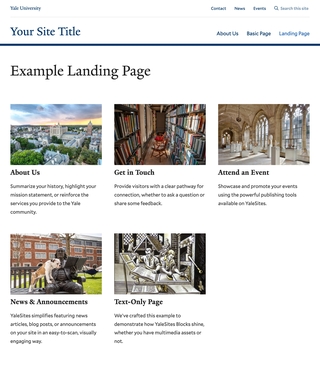
Layer Your Content: Snack, Bite, Meal
Not every visitor wants the same depth of information. A layered content strategy helps you serve all of them.
| Type | Description | Examples |
|---|---|---|
| Snack | Ultra-short, attention-grabbing | Headlines, button text, callouts, banners |
| Bite | Brief summary or teaser that delivers quick value | Intro paragraphs, card descriptions, key takeaways |
| Meal | In-depth content for readers who want more | Full articles, detailed guides, downloadable files |
Think of your homepage as a snack, landing pages as bites, and interior pages as meals. Structure your site so readers can go as deep as they need.